1979
1980
1981
1983
1989
1989
1989
1990
1990
1991
1999
2003
2004
2007
2008
June 2, 1979 - John Paul II’s pilgrimage to Poland

The words of Pope John Paul II from his historic homily at Victory Square in Warsaw, "Let Your Spirit descend, and renew the face of the earth, this earth" became one of the first mottoes of the "Solidarność" movement, which arose a year later.
August 1980 - The rise of "Solidarność"

A series of strikes started in 1980 in Gdańsk, which later proliferated across Poland, leading to the legalization of the Independent Self-Governing Trade Union "Solidarność"
December 13, 1981 - Martial law

On December 13, 1981, martial law was imposed as a result of the fears of the communist regime against loosing power and as a result of the growing significance of the independent trade union movement, especially of "Solidarność".
December, 10 1983 - Nobel Prize for Lech Wałęsa

The leader of "Solidarność" is awarded the Nobel Peace Prize in recognition of his struggle "to resolve conflicts and obliterate disagreement through peaceful negotiation."
1989 - Democratic transformation in Poland – Round Table Agreement

For the first time in the Soviet bloc, during the Polish Round Table talks, representatives of the government sat at one table with the representatives of the opposition in a discussion which triggered transformation of the system in the whole region.
June 4, 1989 - Elections

Although these elections were not fully democratic, they still proved to be one of the most ground-breaking moments in the contemporary history of Central and Eastern Europe. In fact, these elections were a referendum "for" or "against" communist rule in Poland.
August 24, 1989 - Formation of the government of Prime Minister Tadeusz Mazowiecki

The Polish Parliament appointed Tadeusz Mazowiecki the Prime Minister of Poland. This was the first non-communist government backed by the former supporters of the communist party in the Soviet bloc.
December 22, 1990 - Wałęsa is the first democratic President of the Third Republic of Poland

On December 22, 1990, the legendary leader of "Solidarność" becomes the first democratically elected Polish President after World War II. To manifest Poland’s breakup with the previous system, Lech Wałęsa accepted the insignia of the presidential power from the last President of the Republic of Poland in Exile, Ryszard Kaczorowski.
September 12, 1990 - Reunification of Germany

In 1989 the Berlin Wall falls and in 1990 the treaty is signed establishing conditions for the reunification of Germany.
1991 - Dissolution of the USSR

On December 8, 1991, the leaders of Russia, Ukraine and Belarus signed the Belavezha Accords establishing the Commonwealth of Independent States. On December 26, 1991, the Soviet Union ceased to exist. Many nations regained their sovereignty.
March 12, 1999 - NATO Enlargement

Poland, Hungary and the Czech Republic joined the North Atlantic Treaty Organization.
2003 - Colorful Revolutions

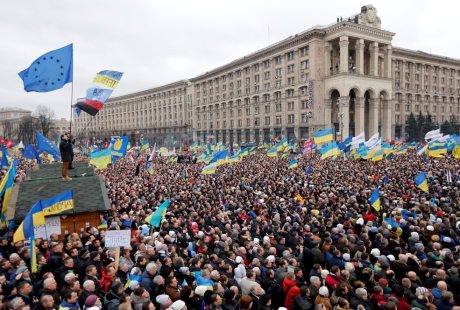
The revolutions in the post-Soviet republics started in protest against the forged elections in the Republic of Georgia. In 2004, the Orange Revolution erupted in the Ukraine, a year later there was a revolution in Kirgizia.
May 1, 2004 - Enlargement of the European Union

Ten Central European countries became members of the EU. This event became a symbol of the unity of the continent and of the end of the Yalta divisions.
December 21, 2007 - Enlargement of the Schengen Area

Alongside the eight other new member states of the European Union, Poland joined the Schengen area, as a result of which internal border controls were abolished. This was another step in the direction of a deeper European integration.
2008 - ... - Solidarność for the Future

Thanks to "Solidarność" today we can enjoy freedom in the united Europe. We mustn’t forget, however, that many nations do not have this privilege. It is our duty to remain in solidarity with those who have pro-democratic aspirations in Belarus, Cuba, Tibet, China, and in all those places where people are refused the right to freedom and self-determination.

“Solidarność for the Future” Project

Initiated by the Lech Walesa Institute Foundation, the “Solidarność for the Future” project aims to educate the young and remind the international community about the significance of Solidarność in the non-violent struggle for freedom and independence.

The non-violent revolution of Solidarność, waged for the right to dignified living standards and societal development, tore down the walls and severed the restraints on freedom. It also triggered the stunning economic transformations both in Poland and across the whole region of Central and Eastern Europe.
Since 2008 on 29th September Gdańsk held the Lech Wałęsa Award Ceremony, an international conference and workshops for youth, where our guests debate about new sense of Solidarity in globalised world


News

Lech Walesa Award 2010

This year the Lech Walesa Award will be granted for the third time.
We are waiting for the nominations until July 15.


Human Rights in the World

Journalist Missing in Ukraine

The chief editor of a weekly newspaper based in the eastern Ukrainian city of Kharkiv has been missing for nearly a week and police are investigating possible foul play, RFE/RL's Ukrainian Service reports.

Publications

The Roads to freedom - the roads to our shared Europe

The Roads to freedom - the roads to our shared Europe

Publications

Report from the conference "From Solidarność to Freedom"

created by:4 Green Elephants